
Introduction
Every TikTok creator eventually asks the same question: how many hashtags can I use on TikTok—and does the number actually matter? The answer is more nuanced than a single digit. TikTok does not enforce a hard hashtag cap the way some platforms once did, but your caption has a character limit, your audience has limited patience, and the algorithm in 2026 reads hashtags as classification signals—not magic reach buttons.
Hashtags still matter because they help TikTok understand what your video is about, who might want to watch it, and where it belongs in Search, discovery feeds, and topic clusters. Used well, they connect your content to intent. Used poorly—stuffed, copied, or irrelevant—they can dilute your message, attract the wrong viewers, and drag down retention metrics that matter far more than any tag.
That is why creators who only chase trending hashtags often plateau. In 2026, TikTok SEO—keywords in captions, spoken audio, on-screen text, watch time, saves, and shares—frequently outperforms a caption crammed with viral tags. Hashtags are one layer of a larger visibility system. This guide explains exactly how many to use, which types work best, and how to build a hashtag strategy that supports search ranking instead of fighting it.
Whether you are a beginner posting your first clips or an advanced creator optimizing for TikTok Search, you will leave with clear counts, real examples across industries, a comparison framework, and a checklist you can apply before every upload. TokBoostly helps creators turn visibility into growth—use this guide to earn reach organically, then amplify your best-performing videos when social proof accelerates momentum.
Recommended count
3–5
Sweet spot
Caption limit
4,000
Characters
Niche tags
2–3
Per video
Trending tags
0–1
When relevant
Caption Limits and Hashtag Math
A useful rule: keep hashtags under roughly 120 characters total—about fifteen to twenty percent of a short caption. Long tutorials can carry slightly more if tags stay topical.
Count characters before posting from desktop workflows. Mobile previews truncate captions; place your primary keyword phrase in the first line, hashtags after the human-readable hook or at the end—whichever matches your niche convention.
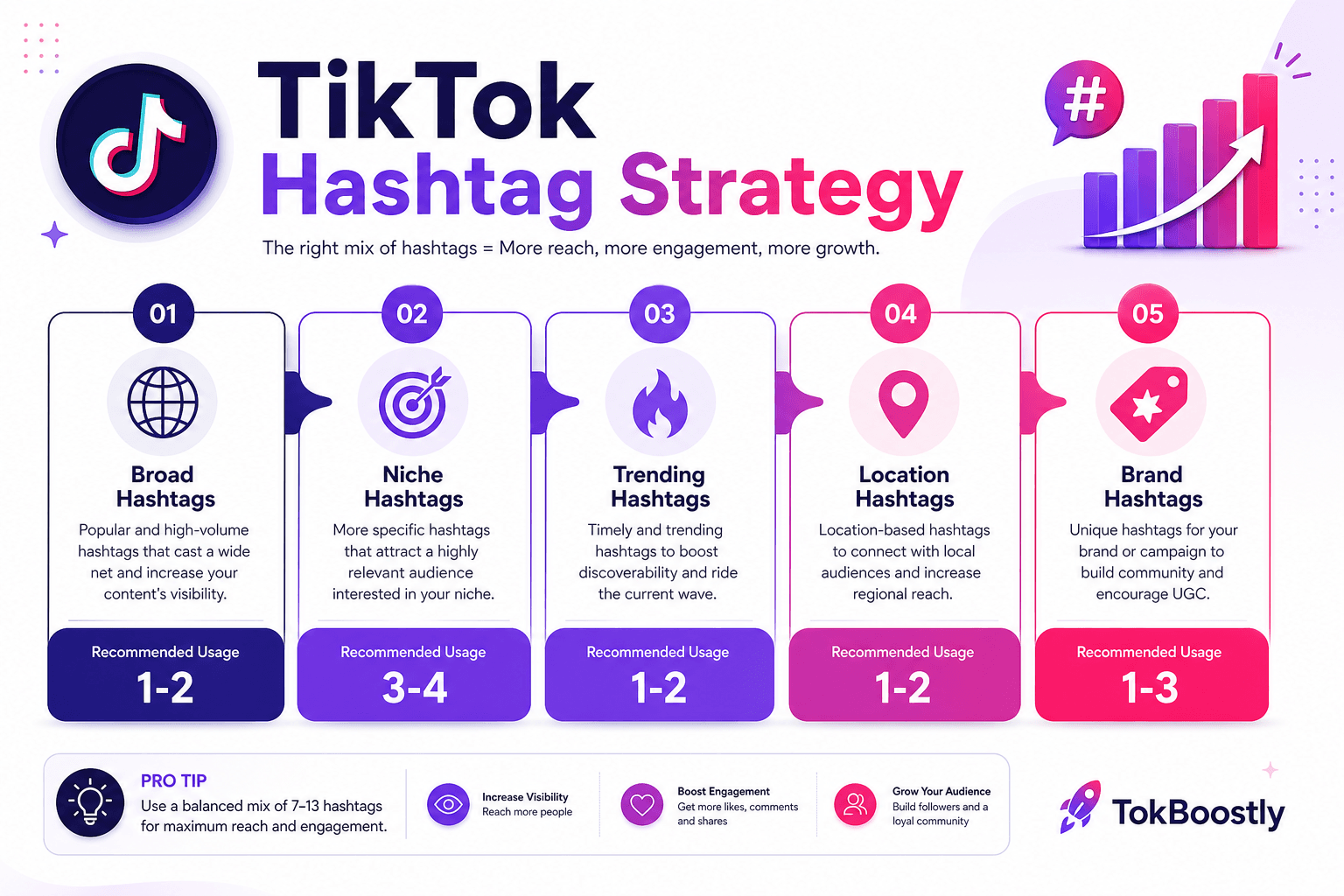
Match hashtag type to your goal. Niche and evergreen tags usually deliver the best search ROI.
| Hashtag type | Recommended usage | SEO value | Competition | Best for |
|---|---|---|---|---|
| Broad | 0–1 | Low–Med | Very high | Context only |
| Niche | 2–3 | High | Medium | Most creators |
| Industry | 1 | Med–High | High | B2B & services |
| Location | 1 | High (local) | Low–Med | Local businesses |
| Brand | 0–1 | Med | Low (owned) | Campaigns & UGC |
| Campaign | 0–1 | Med | Varies | Launches |
| Evergreen | 1 | Med–High | Medium | Tutorials & how-tos |
Hashtag Examples
Business / SaaS: Caption hook "3 onboarding emails that reduce churn." Tags: #saas #customersonboarding #b2bmarketing #startuptips
Fashion: "How to style wide-leg trousers for work." Tags: #workwear #fashiontiktok #styletips #officelook
Fitness: "10-minute kettlebell finisher." Tags: #kettlebellworkout #homeworkout #strengthtraining
Beauty: "Glass skin routine for oily skin." Tags: #skincareroutine #glassskin #oilyskin #beautytips
Gaming: "Ranked climb tips for controller players." Tags: #gamingtips #controllergaming #rankedplay #fps
Education: "Explain photosynthesis in 45 seconds." Tags: #studytok #sciencefacts #biology #learnontiktok
Travel: "48 hours in Lisbon on a budget." Tags: #lisbontravel #budgettravel #europetrip #traveltips
Food: "One-pan lemon chicken for weeknights." Tags: #easyrecipes #dinnerideas #chickenrecipes #mealprep
Technology: "iPhone battery settings you should change." Tags: #iphonehacks #techtips #ios #smartphone
Local coffee shop: "New seasonal latte drop this Friday." Tags: #AustinCoffee #latteart #coffeeshop #austintx
Advanced mix example: Broad #contentcreator + niche #tiktokseo + industry #digitalmarketing + evergreen #tutorial = four tags, one story.
Common Hashtag Mistakes
Too many hashtags: Stacks of ten to twenty tags look spammy, waste caption space, and confuse classification. Fix: cap at five relevant tags.
Irrelevant hashtags: Tags copied from viral videos outside your niche attract low-retention viewers. Fix: every tag must describe your actual video.
Copying competitors: Rival tag blocks ignore your unique angle and audience. Fix: research competitors, then choose tags matching your subtopic.
Using only viral hashtags: #fyp, #viral, and #foryou do not replace topical tags. Fix: one optional broad tag plus niche specificity.
Repeating the same hashtags forever: Stale tag sets miss new search opportunities. Fix: rotate monthly; keep a core branded tag if applicable.
Ignoring keywords: Hashtags without caption keywords and spoken phrases underperform in TikTok Search. Fix: write a keyword-rich first caption line.
Banned or misleading tags: Policy violations hurt distribution. Fix: verify tags on TikTok before campaigns.
Hashtag stuffing in comments: TikTok primarily indexes caption hashtags. Fix: put tags in the caption, not a comment.
| Mistake | What hurts reach | Better approach |
|---|---|---|
| Too many hashtags | 10–20 tags crammed in every caption | 3–5 relevant tags with room for keywords |
| Irrelevant tags | Copying viral tags from unrelated niches | Tags that describe this specific video |
| Only #fyp / #viral | Generic viral tags on every upload | Niche tags + optional one broad tag |
| Same tags forever | Identical block on every post for months | Monthly rotation with core niche consistency |
| No caption keywords | Hashtags only, weak first caption line | Keyword-rich hook + aligned hashtags |
| Ignoring retention | Perfect tags, weak hook, early drop-off | Value in first 2 seconds, tags support topic |
Best TikTok Hashtag Strategy for 2026
Step 1 — Define the searchable topic: Before filming, write one sentence: "This video helps [audience] achieve [outcome] about [topic]." That sentence drives keywords and tags.
Step 2 — Research inside TikTok Search: Type your topic, note autocomplete phrases, and inspect top videos' tags—not to copy, but to identify gaps you can fill with clearer answers.
Step 3 — Build a tag set template: Create three rotating templates for your niche (e.g., tutorial, story, product). Each template lists four approved tags. Consistency speeds publishing without repetition.
Step 4 — Pair tags with caption keywords: First caption line includes your primary phrase naturally. Add hashtags after the CTA or on a new line—whichever fits your brand voice.
Step 5 — Record voice and on-screen text: Mention the topic aloud; display the key phrase on screen in the first three seconds.
Step 6 — Publish and measure: Track average watch time, traffic sources, and hashtag page impressions in analytics. Drop tags that correlate with weak retention.
Step 7 — Iterate weekly: Replace one tag per week in controlled tests. Document winners in a simple spreadsheet.
Use TokBoostly's free TikTok hashtags generator to brainstorm niche-aligned tags from real data, then validate with your analytics—not guesswork.
TikTok Hashtag Checklist
Run this checklist before every upload. It takes under two minutes and prevents the mistakes that silently cap reach.
Topic clarity: I can state my video's topic in one sentence. Primary keyword appears in the first caption line. Spoken audio mentions the topic in the first ten seconds. On-screen text reinforces the same phrase.
Hashtag count: I am using three to five hashtags—not more. Each hashtag is relevant to this specific video. I am not copying a competitor's unrelated tag block.
Hashtag mix: At least two tags are niche-specific. Broad or trending tags are optional and genuinely related. Branded or campaign tags are included only when appropriate.
SEO alignment: Caption keywords and hashtags tell the same story. I am not relying on #fyp or #viral alone. Location tag included if local discovery matters.
Quality signals: Hook delivers value in the first two seconds. Video length matches the promise. CTA is clear if I want follows, saves, or clicks.
Post-publish: I will review analytics after 48–72 hours and rotate underperforming tags on the next similar video.
- 1
Define one searchable topic
Write a single sentence: who this helps and what question it answers. That drives keywords and tags.
- 2
Research in TikTok Search
Check autocomplete and top results. Note niche tags competitors use—then choose tags for your angle.
- 3
Pick 3–5 aligned hashtags
Two to three niche tags, optional location/brand/campaign tag, at most one broad or trending tag if relevant.
- 4
Write a keyword-rich caption
Primary phrase in line one. Hashtags after the human-readable hook or CTA.
- 5
Align voice and on-screen text
Say your topic in the first ten seconds. Display the key phrase on screen for muted viewers.
- 6
Publish and review analytics
After 48–72 hours, check watch time and traffic sources. Rotate tags that correlate with weak retention.
Conclusion
So—how many hashtags can you use on TikTok? As many as fit in your caption, but the number that actually works in 2026 is usually three to five highly relevant tags that reinforce a clear keyword story. TikTok does not reward hashtag volume; it rewards videos that match intent and keep viewers watching.
Use broad tags sparingly, niche tags consistently, trending tags only when they fit, and branded tags when you want searchable campaigns. Pair every tag with strong TikTok SEO—captions, voice, on-screen text, retention—and measure what earns saves and search traffic.
Start with the checklist on your next upload. Refine one variable at a time. When a video wins in Search or holds exceptional retention, that is when TokBoostly can help you amplify—adding views, likes, followers, and comments so new audiences see credible momentum. Grow smarter with hashtags; grow faster with TokBoostly.
When a hashtag-optimized video holds strong retention, TokBoostly views and likes add credible momentum for new audiences.
Boost your best TikTok videosBrainstorm niche-aligned hashtags with real TikTok data + AI—no signup required.
Free TikTok hashtags generator